Afternoon tea was once reserved for British aristocrats, but today it has become a familiar hotel ritual across many countries, including Malaysia.
At first glance, most afternoon tea sets feel interchangeable: small finger sandwiches, a few scones, neatly plated desserts stacked on a three-tier stand. It’s easy to assume that afternoon tea is essentially the same everywhere.
But in Kuala Lumpur, if you look closely, you can find versions that reflect the city itself—its history, its flavors, and its layered cultural identity.
This Peranakan afternoon tea in Kuala Lumpur is one such example.
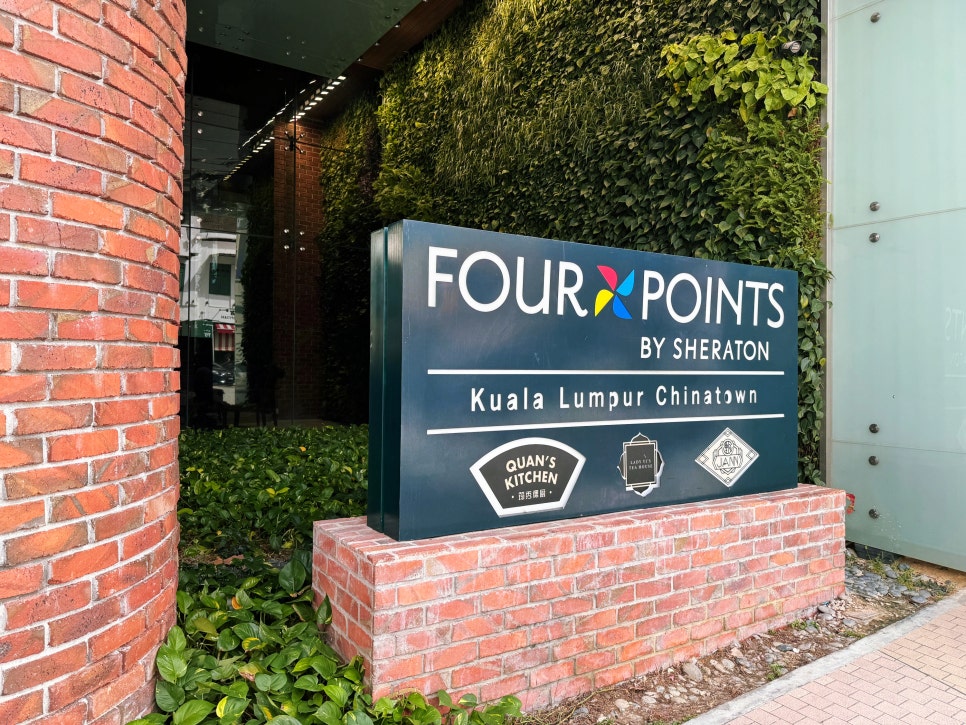
Four Points by Sheraton Kuala Lumpur Chinatown
Opened in 2019, Four Points by Sheraton Kuala Lumpur Chinatown sits right at the edge of Chinatown, one of the city’s most crowded and energetic areas. Grab rides into the neighborhood can be slow when Chinatown gets crowded, so it’s worth factoring in extra travel time.
Once inside the hotel, head up to the 7th floor lobby, where the destination for this afternoon tea experience is tucked quietly behind the main reception area.
Interestingly, this floor is also home to JANN Bar, which is famous for offering one of the best sunset views of Merdeka 118 in Kuala Lumpur. If you’re planning to stay until evening, it’s the perfect spot to transition from a refined tea session to a sophisticated cocktail hour.”
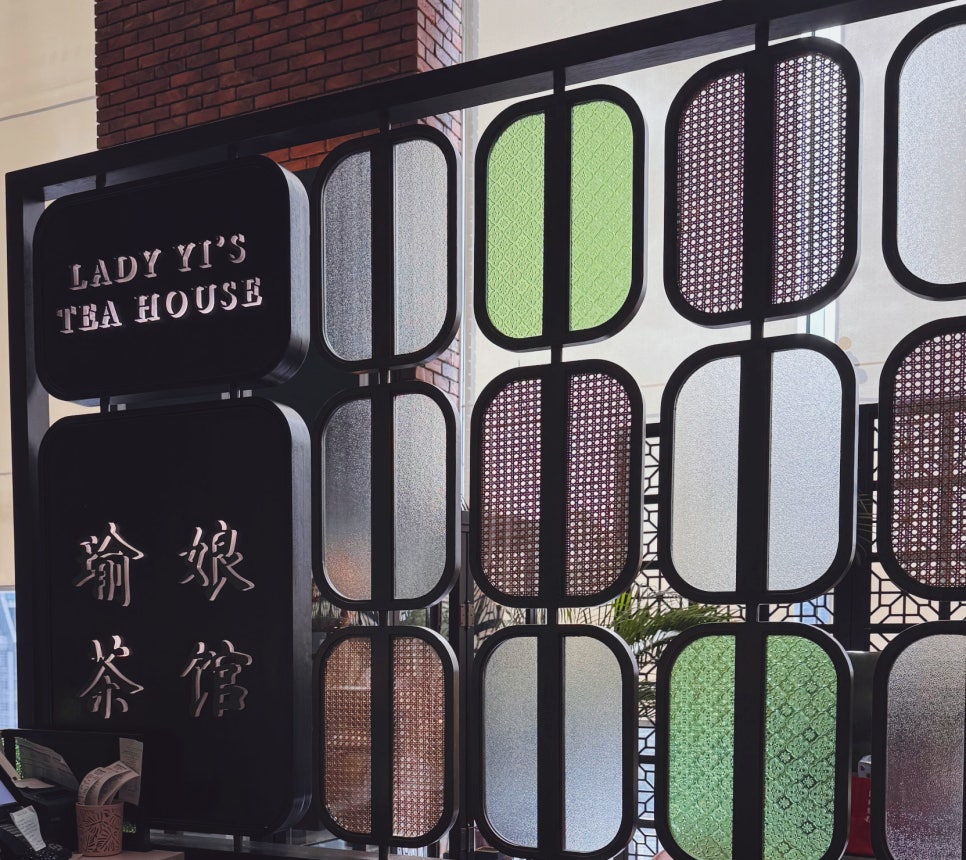
Lady Yi’s Tea House: A Peranakan-Inspired Setting
The venue is called Lady Yi’s Tea House. The lobby itself reflects its Chinatown location, decorated with deep green walls, Chinese porcelain, and traditional motifs.
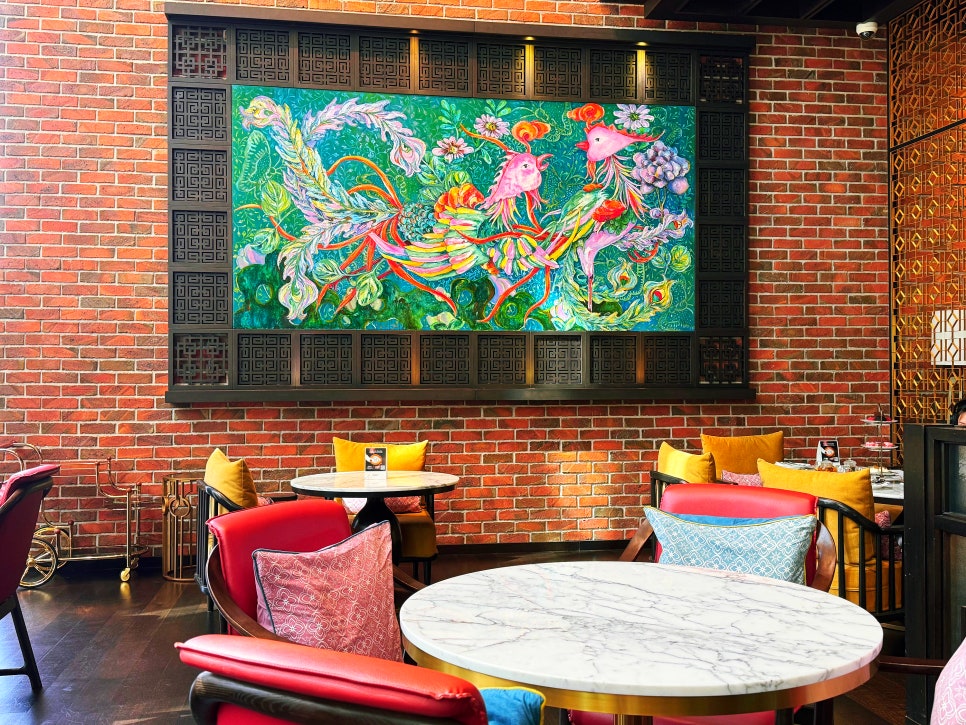
Lady Yi’s Tea House feels calm and intimate, especially on a weekday afternoon. Exposed red brick walls recall renovated industrial spaces, while intricate Chinese lattice patterns and a large phoenix mural anchor the room in tradition. Marble tables are paired with wooden chairs upholstered in red leather, each finished with colorful cushions featuring traditional patterns.
It’s understated, but thoughtfully detailed.
Reservations and Tea Selection
We made a same-day phone reservation through the hotel lobby, just to be safe. Whether walk-ins are accepted isn’t entirely clear, so if you want to avoid uncertainty, calling ahead is recommended. After the initial reservation call, the hotel follows up with a confirmation call.
One small tip: if you have a foreign name, it helps to spell out both your first and last name clearly over the phone.
Online reservations are also available through SevenRooms.
Before the food arrives, you’re asked to choose a tea to accompany the set. The menu includes black teas, green teas, and oolong teas. Since it was our first visit, we chose Lady Yi’s Signature Blend, a fragrant tea with dried flowers mixed into the leaves.
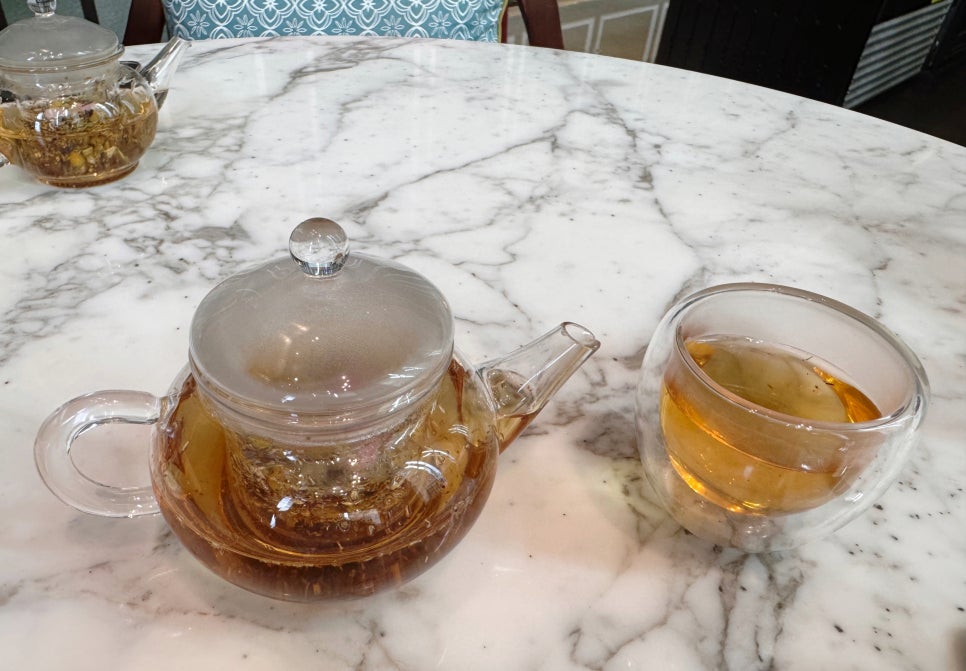
What Makes This Afternoon Tea Different
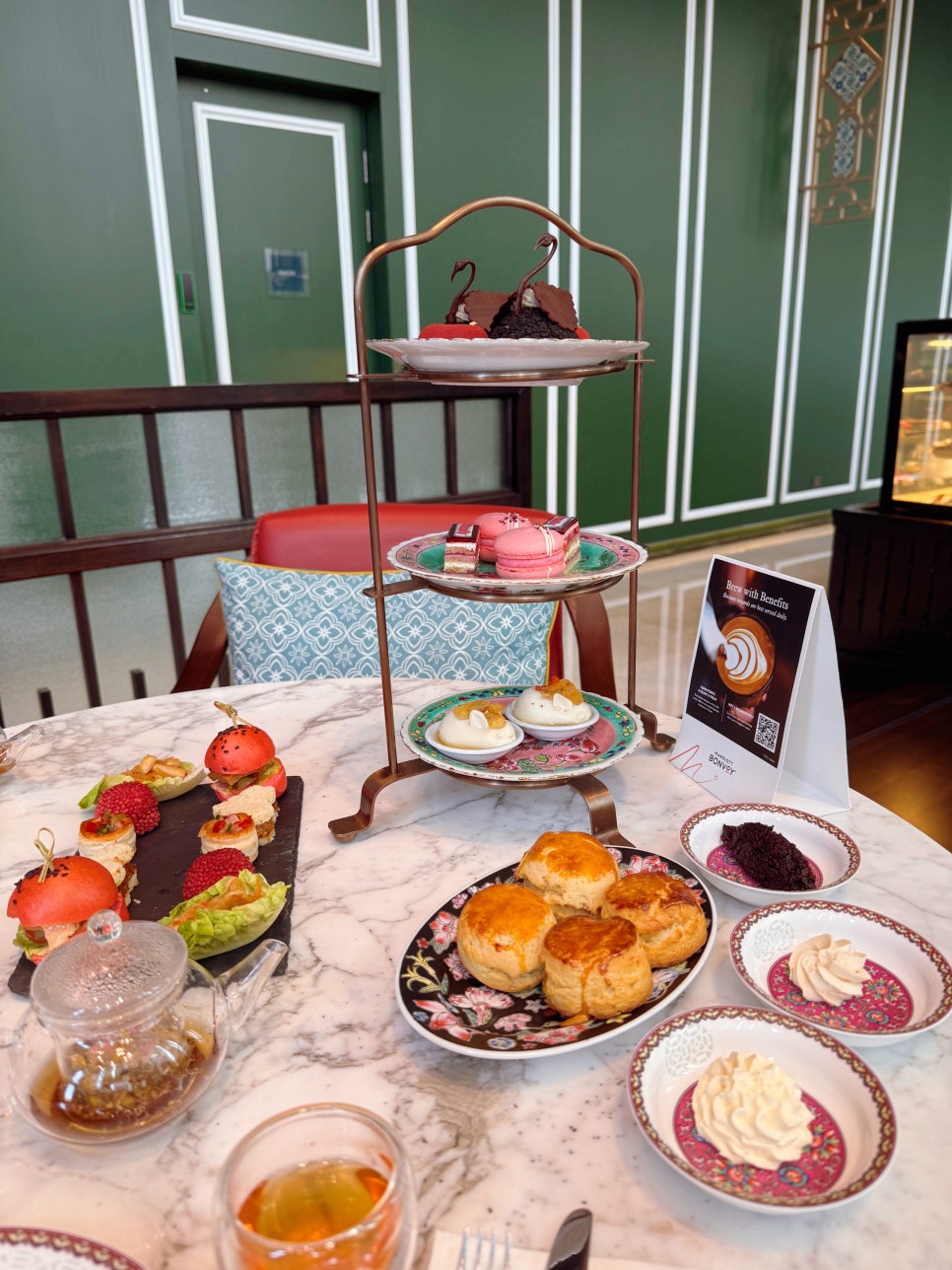
The afternoon tea set is served with a three-tier stand, four scones, a selection of savory finger foods, and an assortment of spreads: buttercream, ginger cream, and hibiscus jam.
What sets this experience apart, however, is how clearly it reflects its location.
Rather than following a strictly Western template, the menu incorporates Peranakan influences, a culinary tradition shaped by Chinese ingredients combined with Malay and Indonesian spices. Typical Peranakan flavors come from the way Chinese staple ingredients such as tofu, mushrooms, and pork are combined with Malay and Indonesian aromatics and spices. Coconut milk, lemongrass, and galangal add layers of fragrance and acidity, resulting in dishes that feel both familiar and complex.
These elements appear throughout the savory items.
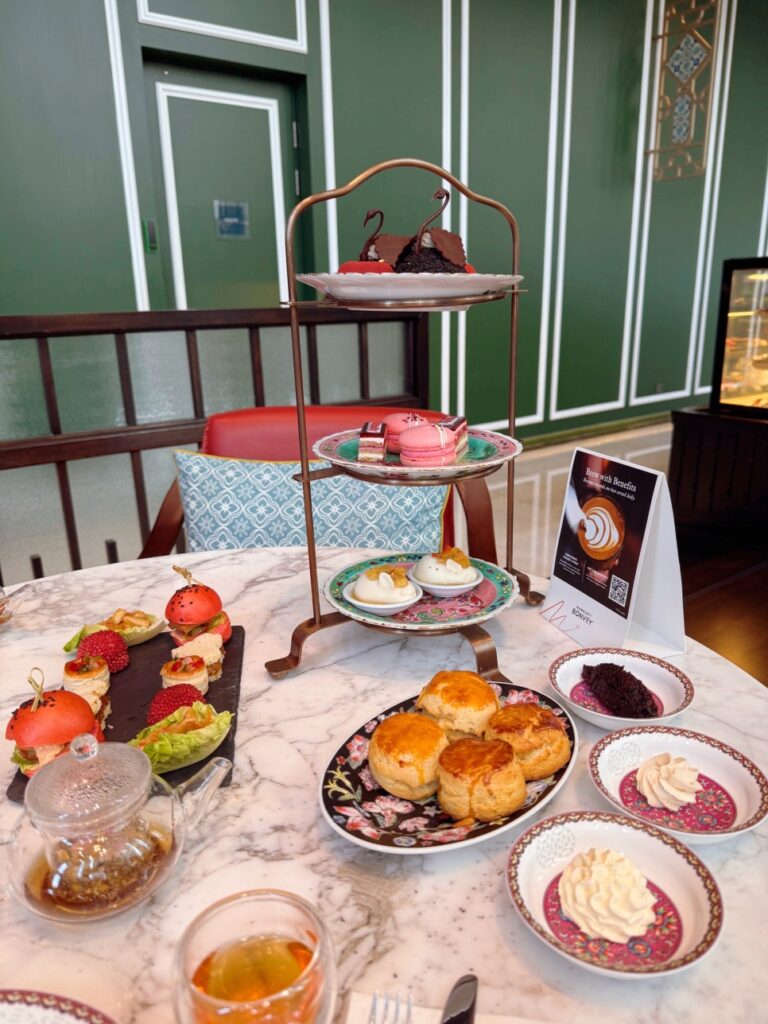
Savory Highlights
The savory course was easily our favorite part of the set.
Small cabbage wraps filled with soy-based sautéed mushrooms were pleasantly savory and noticeably salty. The sandwiches carried a subtle heat, while the mini burger replaced a standard beef patty with a tofu-like square patty paired with a lightly spicy mayonnaise.
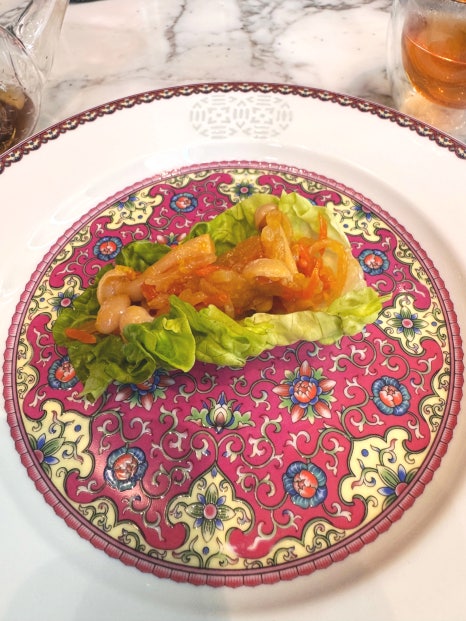
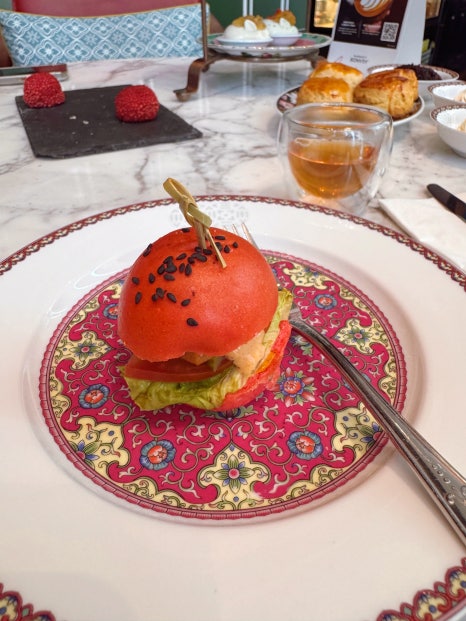
One item that looked like red jelly turned out to be a shrimp-based fish cake, shaped to resemble a lychee, offering a playful contrast in texture.
These dishes felt intentional and rooted in local flavors, rather than decorative.
Scones and Spreads
The scones came with three accompaniments: buttercream, ginger cream, and hibiscus jam.
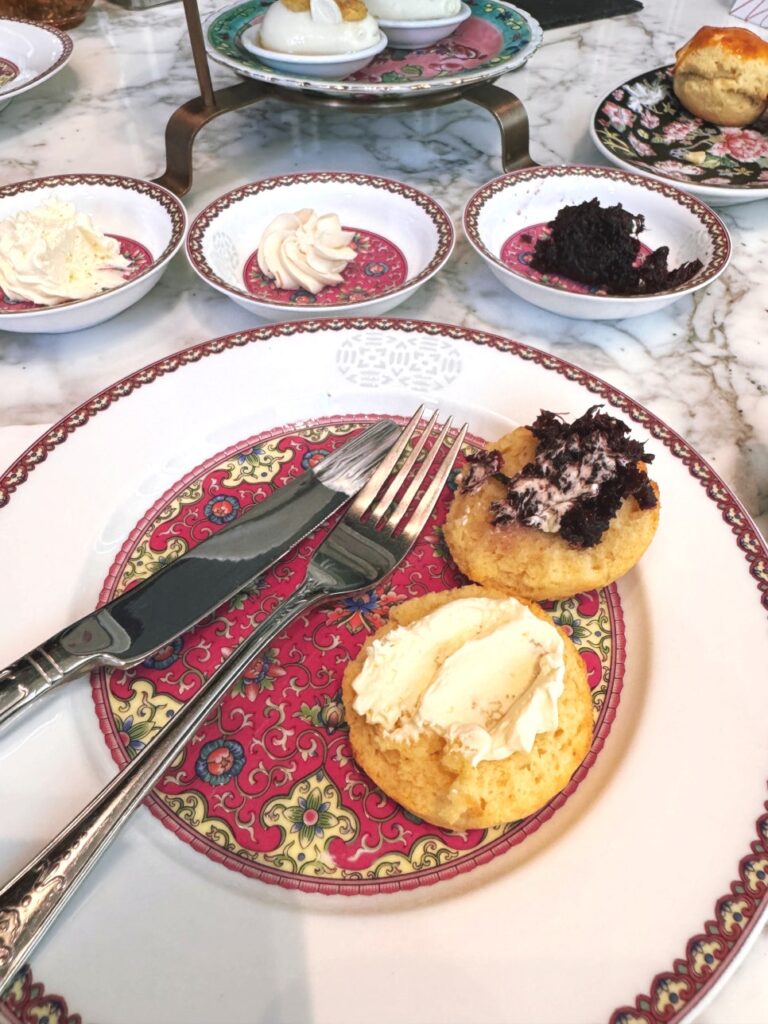
Hibiscus is more commonly encountered as tea, so tasting it in jam form was unexpected. The jam was gently sweet, lacking the tangy sharpness I remembered from hibiscus tea. The ginger cream sounded intimidating at first, but it was subtle—mostly creamy, with a mild ginger warmth appearing at the end.
It worked better than expected.
Desserts: Mixed Impressions
Desserts occupied the top tiers of the stand. One noticeable miss was the macaron, which we skipped photographing. According to the staff, it was strawberry-flavored, but it lacked any clear strawberry character.
The remaining desserts were more interesting visually: a square mousse cake, a crane-shaped choux pastry, and a heart-shaped mousse cake filled with a passion fruit–like syrup. Both the square cake and the choux pastry were filled with black sesame cream, which was flavorful but began to feel heavy after the scones.
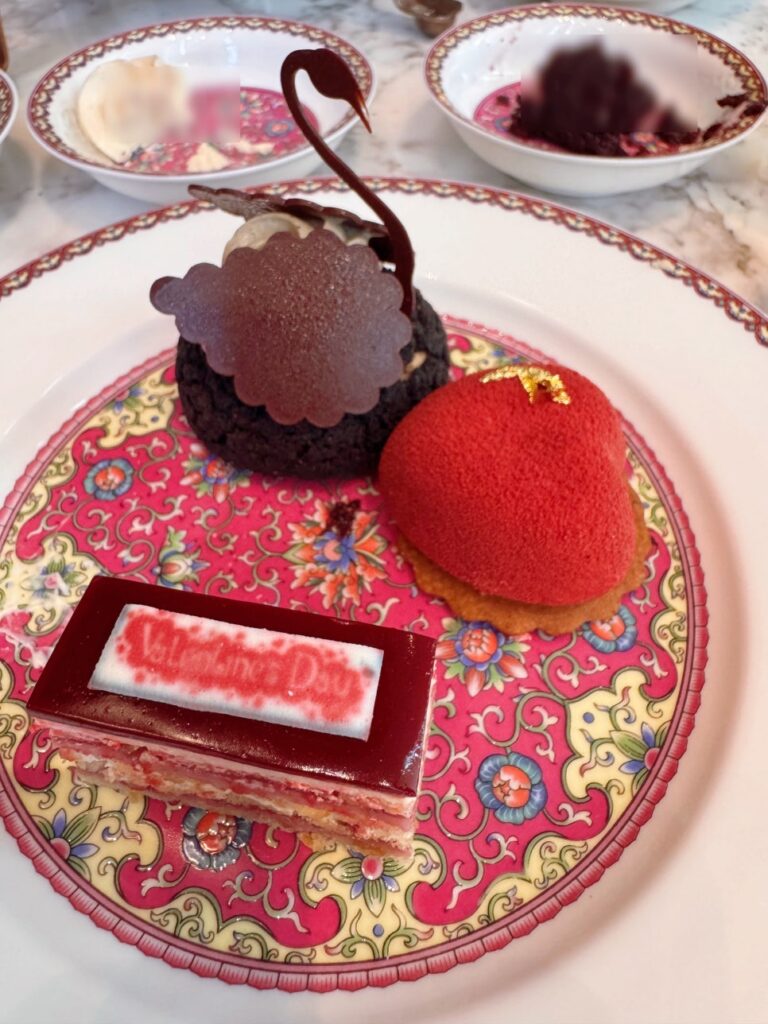
In hindsight, pairing the set with a more bitter tea might have balanced the sweetness better.
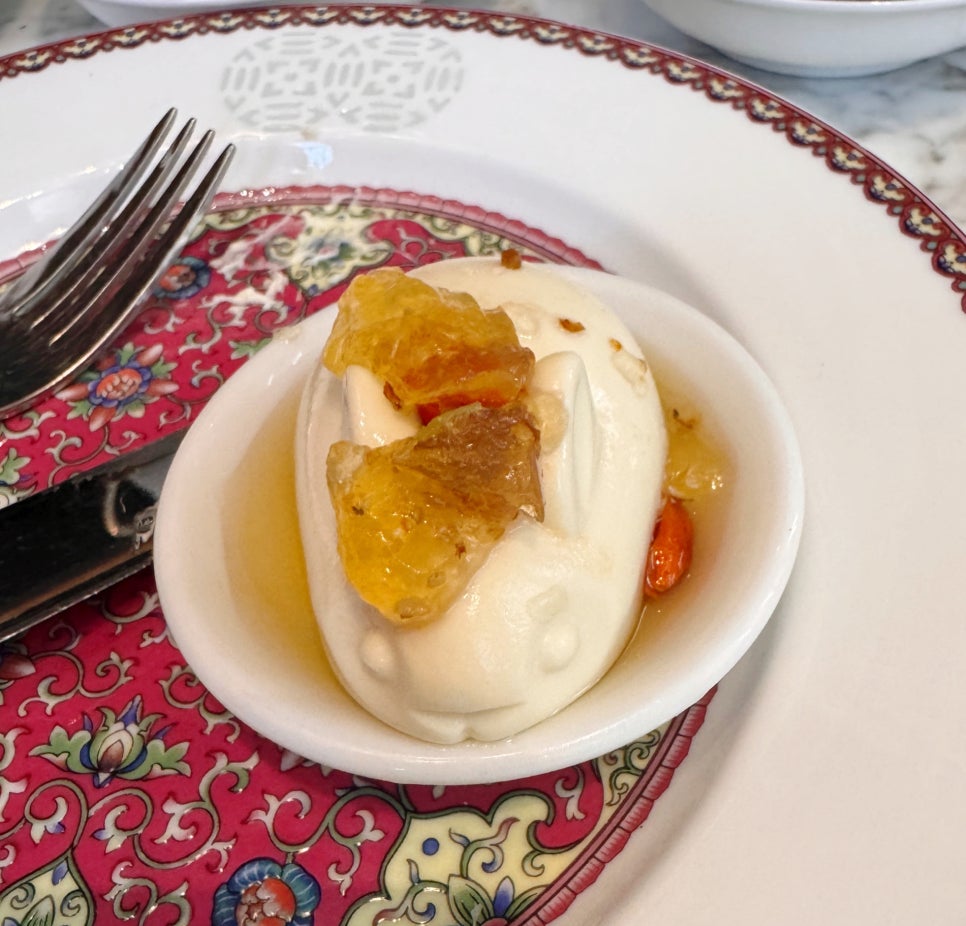
The final dessert was a rabbit-shaped panna cotta. Its appeal lay more in its appearance than its flavor, evoking the rabbit-shaped buns commonly seen at dim sum restaurants. Its soft, pudding-like texture suggested dairy, but it turned out to be made with soy milk. The flavor was mild and clean, with no strong soy aftertaste.
Price and Value
- Afternoon Tea Set for Two: RM 178 (nett price)
(Subject to SST and service charge)
At the time of my visit, this translated to approximately USD 45, depending on the exchange rate in early February 2026.
With the Malaysian ringgit relatively strong, the converted price may feel higher than expected. Still, for a hotel afternoon tea—particularly one built around Peranakan-inspired flavors and a Chinatown context—the value felt reasonable.
This is not an experience easily replicated in many other countries, where afternoon tea tends to follow a more standardized, Western format.
Beyond Afternoon Tea
Lady Yi’s Tea House also offers tea-blending workshops, where guests can sample base teas and experiment with different flavoring ingredients. While we didn’t join a session ourselves, it’s a notable option for those interested in tea beyond the standard hotel experience.
Final Thoughts
The more people travel, the more they tend to seek out a sense of place. Afternoon tea at Lady Yi’s Tea House isn’t about luxury for its own sake—it’s about localization.
Experiences like this remind you that hotels can be more than neutral spaces. When done thoughtfully, they can reflect the culture around them, even in something as familiar as afternoon tea.
📍 Location
Lady Yi’s Tea House Google Maps: https://maps.app.goo.gl/BBTPvFmZsmMujzZf7🍵 For seasonal menus, tea workshops, and visual details of the space,
you can check their official Instagram: https://www.instagram.com/ladyyisteahouse.kl🗓️ Online reservations are available via SevenRooms: https://www.sevenrooms.com/reservations/ladyyisteahousekulfc/
🎟️ Book a workshop (Afternoon Tea + Hanashibori)
Event page: https://www.idem.events/v/four-points-by-sheraton-kuala-lumpur-chinatown/products/peranakan-afternoon-tea-and-hanashibori-workshop
“Afternoon Tea in Kuala Lumpur: A Peranakan Twist at Four Points Chinatown”에 대한 3개의 생각