A Tragic Tale? Not Quite
A master’s student rummaging through Sweden’s trash bins — it sounds like a sob story, right?
Far from it. If I had to name the genre of this episode, it would be less tragedy and more adventure.
It was early spring 2016 in Gothenburg, Sweden’s second city, where warmth doesn’t truly arrive until May. March and April are spring in name only — nothing like the cherry-blossom dreams of Korea.
That night, my friends and I had a plan. We were to gather at a “secret” spot: the Netto supermarket near our dorms, its yellow sign glowing like a beacon. Once it closed, our mission would begin.
Our crew was a dazzling lineup of Gothenburg University master’s students from Sweden, Germany, Belgium, and South Korea, studying lofty fields like international human rights, social work, and public health. Noble, right?
Source: are.na
Our cause was nobler still: rescuing food waste in a world drowning in it.
The Noble Art of Food Rescue
Food waste, you ask? Think perfectly edible ingredients — maybe slightly bruised or past their sell-by date — thrown out by supermarkets for lacking “market value.”
Our mission wasn’t just about empty student wallets. It was about saving these castaways and pushing back, however slightly, against the global food waste crisis.
Step one was choosing the right supermarket. Our criteria were simple:
- An exposed trash area
- Easy access for a sneaky crew
Netto checked both boxes. A lone yellow-signed store in a desolate lot, with a dumpster tucked behind a sparse wooden fence. It wasn’t Fort Knox, but the fence clearly said: Stay out.
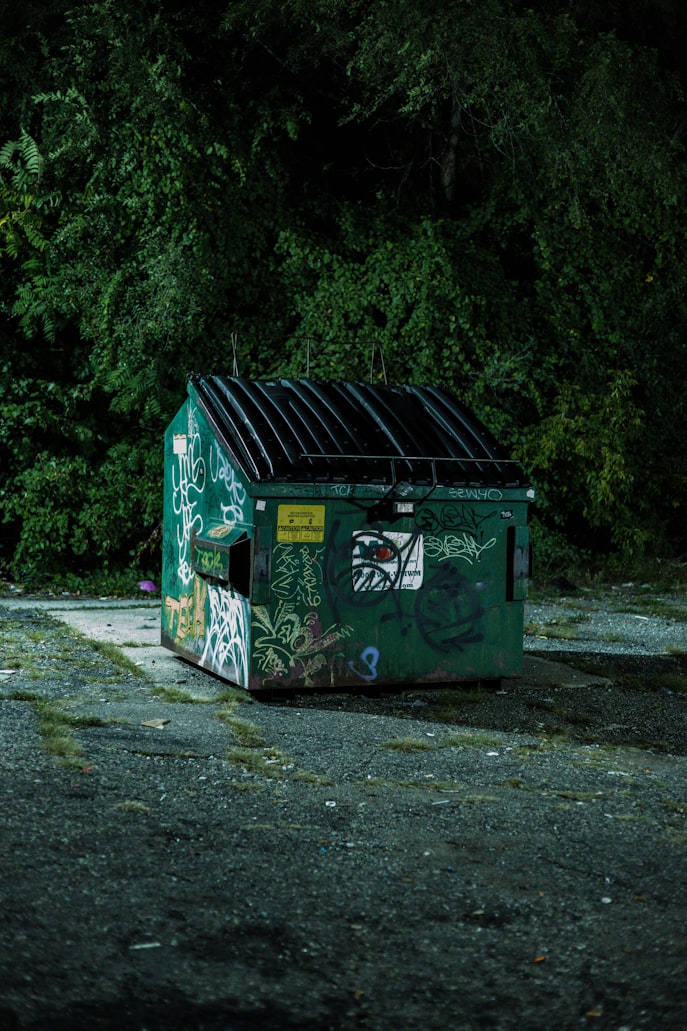
Photo by Bruno Guerrero (Unsplash).
My European friends, ever eco-conscious, preached the gospel of food rescue.
“You’ll see how much good food gets wasted,” they said.
“It’s not stealing — it’s saving.”
Bruised apples. Slightly cracked carrots. Still edible, yet discarded for not being “pretty.”
Meanwhile, people starve across continents — even just a bit north of Seoul.
My head understood it. Food rescue, not theft. A noble cause across Europe, they said.
Fine. I was in.
Operation Food Rescue.
The Nighttime Heist
The night air was sharp and cold. We watched Netto’s lights flicker off — the signal.
Six pairs of eyes met in the darkness.
Next step: climbing the wooden fence.
Easy, right?
I told myself I was here to save the planet, reduce waste, rebirth food — and maybe ease my broke-student grocery bill. But staring at that fence, doubt crept in.
Was this private property?
Was I trespassing?
Would some Swedish security alarm start screaming?
Maybe it was my Korean “land of courtesy” upbringing. Maybe I was just a lifelong goody-two-shoes.
The fence wasn’t tall — just above my 164 cm height. But my European crew were giants.
- P from Germany (181 cm)
- L from Belgium (180 cm)
- A from Germany (175 cm)
- M from Sweden (170 cm)
Even S from Germany, the shortest at 158 cm, hopped over effortlessly.
And me? I hesitated.
After what felt like an eternity, I finally landed on the other side. My friends were already rummaging, unfazed. I ditched my manners and joined in.
What we found was shocking.
Pristine lettuce.
Unblemished oranges.
A six-pack of hard rolls.
Even a sack of rice.
No rot. No mold. Just discarded for not being “perfect.”
This wasn’t trash.
It was treasure.
Photo by the author.
The Loot and the Lesson
I claimed a six-pack of hard rolls, a head of lettuce, and three oranges. S and A — dorm-mates with a shared kitchen — boldly took the rice sack.
Back home, I froze the rolls, washed the lettuce (peeling off one outer leaf revealed perfection), and rinsed the oranges.
The rolls, warmed in the oven with a dish of water, tasted freshly baked. Almost too perfect.
It felt good — and bitter.
If this much edible food was tossed in one Gothenburg dumpster, how much was wasted worldwide?
For a week, my lunches were hard-roll sandwiches: tuna salad with onions and pepper, or egg salad layered with crisp lettuce. The rice sack became a curry-fried rice salad with raisins and almonds for a dorm party.
A glow-up, indeed.
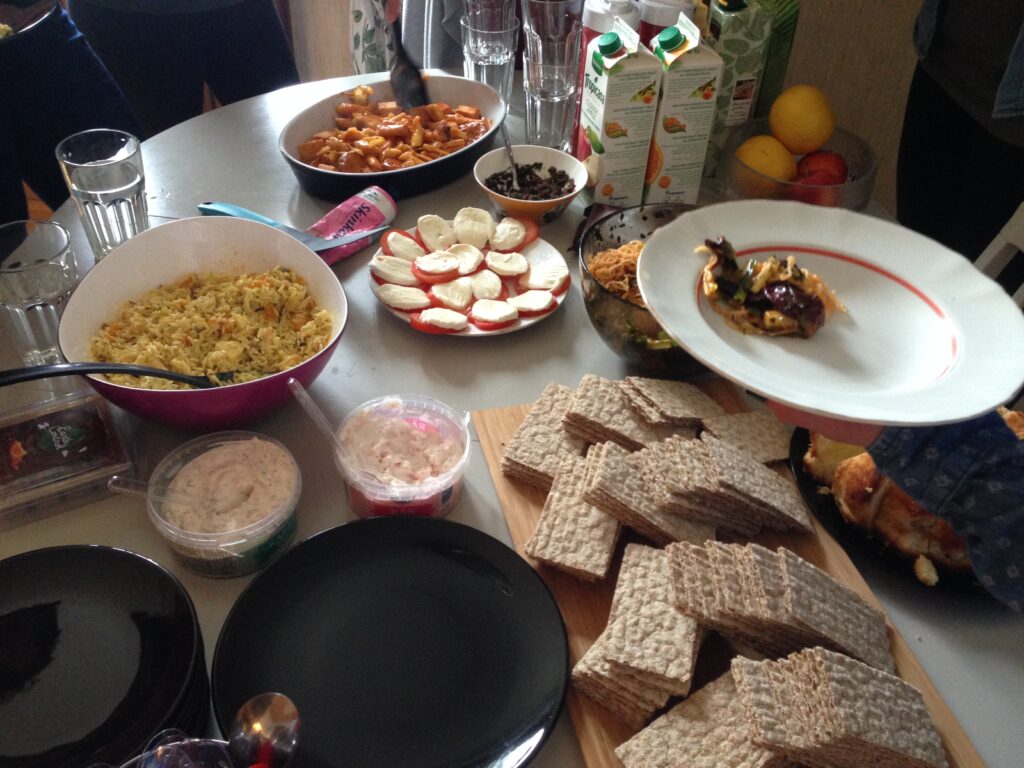
Photo by the author.
A One-Time Adventure
My dumpster-diving debut was a one-hit wonder. My friends kept rescuing food and inviting me along, but I never quite shook the fence-climbing jitters.
Still, I ate happily from their hauls, sharing meals and stories.
That night didn’t teach me something entirely new, but it made something I already knew feel suddenly real — how much perfectly good food gets thrown away.
In Gothenburg’s polished, “perfect” streets, I found an unfiltered truth.
Even the so-called land of happiness has its flaws.
Welcome to Bare Scandic.