Note to Readers: In my previous post, "Finally Securing Student Housing in Sweden: A Stroke of Luck Against 140-to-1 Odds," I shared the story of my miraculous success. But before that victory, there was a dark chapter I haven't revealed until now. This is the prequel—the raw story of how I fell victim to a meticulous housing scam in Sweden, losing both my savings and my hope in the so-called "happiest" land on earth.
The Big Decision: To Move or Not to Move?
It was early 2017, just before my fourth semester of grad school. I faced a classic dilemma: stay in a depressing share house with a soul-draining housemate, or risk everything for a new start.
My parents urged me to stay put via KakaoTalk. But as the eldest daughter of a Korean family—with a 30-year track record of healthy rebellion—I knew my answer: “Not listening to my parents is the only way I survive.”
House Hunting in Sweden: The Captain vs. The Student
I scoured Blocket.se, Sweden’s go-to platform for everything from vintage sofas to apartments.
A Near Miss: My First Encounter with a Housing Scam in Sweden
Before I narrowed my search down to the final two candidates, I almost fell for a textbook trap. I found a stunning apartment at an unbelievable price and was ready to wire the deposit. However, a tiny detail caught my eye: the bank account provided wasn’t Swedish; it was registered in a country in Africa.
I dodged that bullet. That “Red Flag” was so obvious that it gave me a false sense of security. I thought, “I know how to spot a housing scam in Sweden now. I just need to find someone with a local presence.” With that misplaced confidence, two real options finally emerged:
Two options emerged:
- The Captain’s Vintage Flat: A grand, wooden apartment on the 4th floor. It was beautiful but had one fatal flaw: no elevator. Thinking of my previous move that nearly killed me, I reluctantly declined.
- The Modern Dorm: A sub-sublet from a German man named Holger. It was clean, cozy, and most importantly—it had an elevator.
The Meticulous “German” Trap: Why I Lowered My Guard
After dodging that international “Red Flag” with the African bank account, I felt like an expert. I thought I knew exactly how a housing scam in Sweden worked: a predictable, non-face-to-face pattern where scammers post fake listings, claim to be overseas, and disappear the moment a deposit is wired.
But Holger didn’t fit that profile at all.
He was a person, not a ghost. He was tall, wore glasses, and had a fastidious, “proper German” demeanor. Because we met in person at Espresso House, and because he had a local Swedish bank account, my hard-earned vigilance evaporated. I fell for his meticulous trap precisely because it wasn’t the “typical” scam I had just narrowly escaped.
We signed a seemingly legitimate contract, and I handed over 3,000 SEK in cash as a deposit. Later, I wired another three weeks’ worth of rent. In total, I sent him 6,700 SEK (approx. $693 USD). It was only when I stood before a locked door on moving day that I realized his “proper” persona was just the most polished part of the scam.
A Surreal Scene: When Locals Give Up
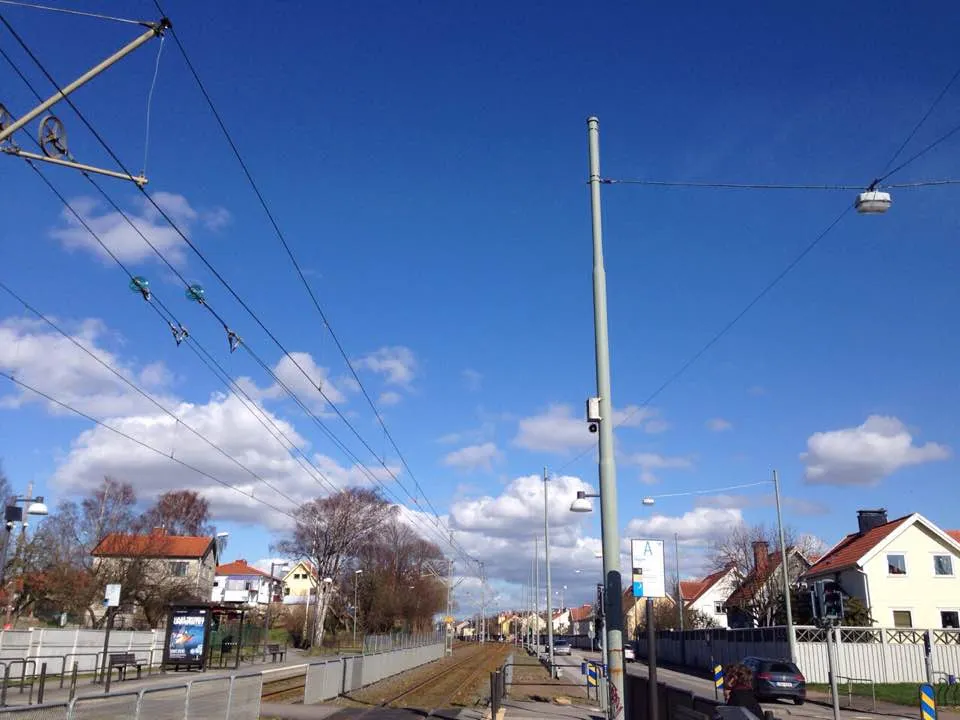
On moving day, I called the intercom. Silence. I called Holger. His phone was off. When I arrived at the dorm, I found eight Swedish students in a frenzy. They had all been scammed by the same man. One student looked at me and asked, “Don’t tell me you signed with Holger, too?”
Strangely, seeing so many victims—mostly locals—gave me an odd sense of relief. It proved that I wasn’t scammed because I was an “ignorant foreigner”; even the Swedes were defenseless against Holger’s meticulous trap. However, the real shock came the next day. When I suggested a collective police report via WhatsApp, my Swedish peers replied:
“It’s pointless.”
They had notified the dorm management but refused to go to the police. This passive resignation from the locals was disheartening. I realized then that if I didn’t fight, my 6,700 SEK would simply vanish into the quiet indifference of the Swedish system.
Fighting the System (and Losing)
I refused to be silent. I started with my bank, Nordea, hoping for a wire transfer reversal. Their response was cold: “No.” Since the money was sent “willingly,” they had no obligation to help.
The next hurdle was the police. Reporting a crime in Sweden required navigating the system in Swedish. Thankfully, my international student mentor, F, helped me file the official report.
The Maddening Reality of Swedish Law Enforcement
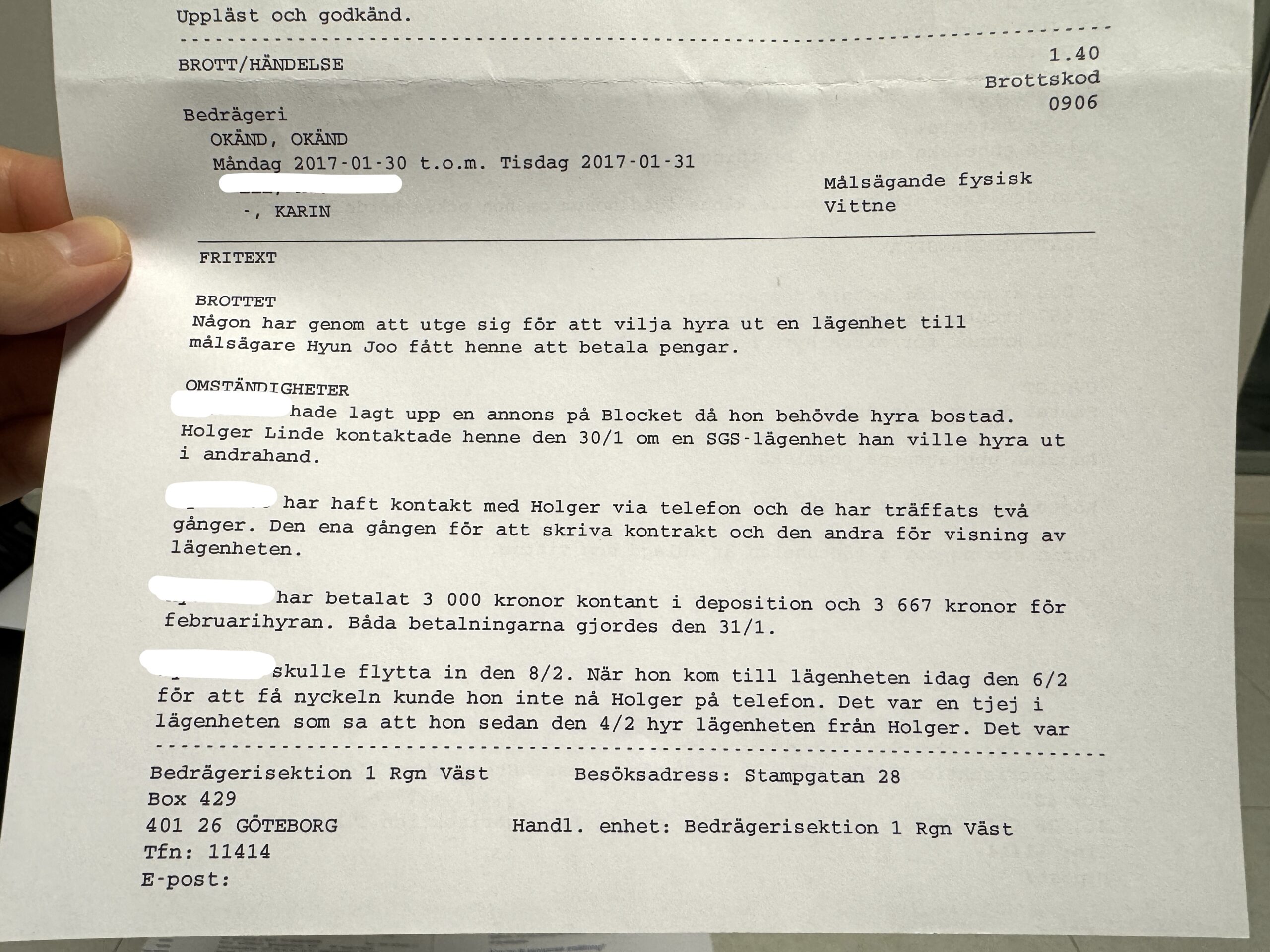
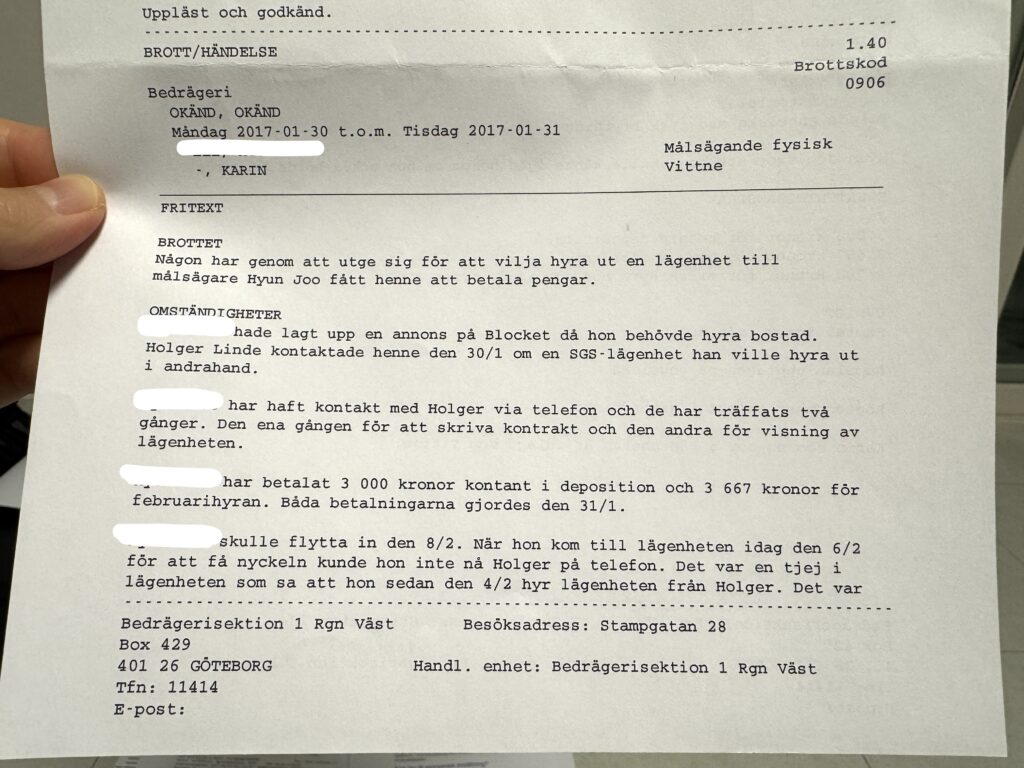
Weeks later, a police document arrived by mail. It revealed a chilling detail: The man used the name “Holger Eduard” on Blocket.se but signed my contract as “Holger Lind.” He was a ghost with multiple names.
When I called the police for an update, the conversation was nothing short of maddening:
- The Border Loophole: Since Holger was a European citizen, there were no border records to track his movements.
- The Priority Problem: The officer told me my case wasn’t a priority due to a “lack of resources.”
- The Ultimate Insult: Then came the question that made my blood boil: “Even if we catch him, do you think he’d have the money to pay you back?”
Outraged by their lack of accountability, I snapped: “Tell your HR department about your staffing issues!” and hung up. I wasn’t just a victim of a scammer; I was a victim of a system that had already decided my case wasn’t worth its time.
Finding Strength in Friends
Life went on. That afternoon, I attended my scheduled seminar on international human rights. By then, the story of my scam had spread among my twenty or so master’s classmates, who greeted me with concerned looks. When I shared the maddening details of my call with the police, they were as furious as I was.
My sharp, no-nonsense German friend, E, finally exploded: “What, do we need to kill someone to get your case prioritized? Should you commit murder just to bump it up the list?”
Hearing these normally gentle, social-work-minded friends suddenly talking about murder made me burst out laughing. Nothing was resolved, but their absurd outrage gave me a surge of energy I desperately needed.
A New Resolve
Being scammed only fueled my determination. For my final semester, I clenched my fists and made a vow to myself: “I will find a home that gives me the best memories.”
🚀 What happened after this nightmare?
That vow wasn’t just talk. Discover how I turned this crushing defeat into a miraculous victory in the sequel:
👉 Finally Securing Student Housing in Sweden: A Stroke of Luck Against 140-to-1 Odds